
Space for Curiousity
- Posted by Jonathan Henriques
- Date September 17, 2026
- Categories Education, Impact
“Hey! It has a smiley face!”
I looked back toward the music staff on my whiteboard. My class had been learning about tied notes, and I had written two quarter notes with a curved tie connecting them:
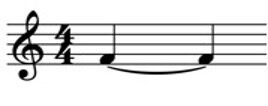
“There’s no smiley face,” I responded, staring at the board and wondering what my student could have seen. Another student chimed in, “Yeah, it’s right there! The notes are smiling at us.”
It took me longer than I would care to admit before I finally saw what my students were seeing. The curse of adulthood and long experience prevented me from looking at the notation from a fresh perspective. I chuckled. “Oh my gosh, you’re right. I’ve never seen that before!” I could sense a wave of newfound interest wash over the class. Could there be a frowny face in music? What about an excited face? What other imagery might be hiding? Could someone draw a picture using notes and then play it? What would it sound like?
These were not my questions; they came from the 9-year-olds in the room. I allowed a couple of minutes for them to savor this impromptu digression, and then brought our collective attention back to the lesson at hand.
Of course, there was no formal smiley face. Any resemblance was purely coincidental. And seeing “smiling” notes would not help true understanding of that particular music symbol. But my students didn’t care about that. They looked at this new and unfamiliar notation and saw a warm and inviting face. In that moment, my reaction could have had significant consequences. By permitting my students to ask questions, they seemed to be drawn closer to music. If I had denied them that moment, they might forever remain indifferent.
All beginning students have the ability to relish what is unorthodox, and such a skewed view of a subject can sometimes lead to one of the greatest weapons against ignorance: curiosity. It is the teacher’s responsibility to show students how to leverage their curiosity for productive ends.
The same Latin word that is the source of our word “curiosity” can carry the meaning of being careful, of paying close attention to the small elements of an idea or thing. Curiosity is the propellant that fires us toward new knowledge and deeper understanding. It is, as Samuel Johnson tells us, “one of the most permanent and certain characteristics of a vigorous intellect.” What a shame, then, that many teachers inadvertently spoon-feed a perfunctory curriculum to compliant students who never ask questions that extend beyond the boundaries of the final exam.
Here are some simple tips to help teachers cultivate healthy curiosity in the classroom:
- Most importantly, cultivate curiosity in your own life, and let your students see it. A teacher teaches from a life that spills out in front of others. You’ve likely seen the disastrous results of a dispassionate teacher; the same is true of an incurious one. Know your subject. Even better, seek to learn what you don’t know about your subject, and be open with your students about your own ignorance. I have a colleague who presents a symphony he knows nothing about at the start of every semester and learns about it alongside his students as the first “warm-up unit.” It is a humble and effective way to show his class that there’s always more to learn.
- Have some kind of visual aid handy that reminds everyone about the depth of the subject or subjects you teach. There’s more to math than addition for addition’s sake, but your students aren’t going to remember that while they are hacking down the weeds of their homework. Visibly remind them that there’s more out there.
- Collect and recount great anecdotes from your discipline. As a music teacher, I love sharing little stories about musicians and composers that humanize them in the eyes of my students. Maybe you have a love of etymology or of quotidian history. Find where your interest relates to your subject and share it generously with your class.
- Host a periodic “Ask Me Anything” session. My rules for this exercise are simple: As long as the question is about our subject, is appropriate to ask in class, and is asked in good faith, I will answer it. If I don’t know the answer, I’ll go and find it. (See point one about the teacher’s own curiosity.)
- Be unapologetically enthusiastic about learning. The hard truth is that many of your students already see you as a kind of nerd. Lean into that identity. Be excited about what you teach, and never be ashamed. Be excited about other subjects as well. Never let your students hear you dismiss another subject as irrelevant or unimportant.
There are, of course, dangers lurking in good education, and teaching through curiosity is no different. Here are some ways curiosity can be abused if we aren’t careful:
- Unbridled curiosity can derail a useful lesson. A good lesson has a real, measurable purpose. Sometimes those moments of wonder may have little to do with the task at hand. As teachers, we must discern how much time is appropriate to spend on any digressions and whether a “curious question” might be better answered outside of class.
- Students can sometimes take advantage of what they perceive to be an undirected class. We all have most likely dealt with those perceptive pupils who have mastered the art of asking questions just to avoid doing the actual work of learning. Again, discernment is crucial. You know your students. Is their curiosity in good faith?
- If you are willing and able to answer any and all questions about your subject, you might end up dazzling your students into blindness. As Emily Dickinson suggested, “Tell the truth, but tell it slant.” Make sure that you reveal those awesome insights gradually and in an age-appropriate way so that you don’t intimidate the students’ minds, especially those of younger students. Always keep the central purpose of your lesson in mind, but craft around it the space for curiosity.
These dangers notwithstanding, the warmth of a curious classroom invites students to do the one thing we can’t really see—pondering. This happens in the mind, and teachers rarely see the fruits of a student who carefully weighs the importance of a subject. Pondering is one of those seeds of which we are constantly being reminded.
But a classroom that intentionally makes space for curiosity also creates a rich environment where attentive students can’t help but thrive.
The French poet Charles Baudelaire once remarked, “Genius is no more than childhood recaptured at will.” I am convinced that he thought of childhood as a time when curiosity reigns as the principal driving force for learning. With some caution, we might restate Baudelaire’s comment: “Those who learn to leverage curiosity early will stand out later.”
While encouraging curiosity in our students does not guarantee the flowering of their genius, dismissing their curiosity will certainly prevent it. If we extinguish the flame of curiosity in the hearts of our learners, we will also diminish in them every other ability related to their education. They won’t desire to observe, ask, or wonder. They likely will make little progress in life, because there will be no yearning to move, to grow, or to change. But if we ignite that curiosity flame, we can open up a world of amazement for them. They will live lives not of enervation but of innovation.
Tag:Curiousity, Educators, Online Learning, School

Jonathan lives in Atlanta, Georgia, with his wife, their daughter, and their lively Yorkshire Terrier. With nearly 20 years of teaching experience, Jonathan loves finding ways to bridge the gap between classical traditions and modern life.